
The Legislative & Budget Process in Louisiana
Louisiana Legislative Sessions
The Louisiana Legislature has two “chambers.” They are the House of Representatives and the Senate. They are also called the two “houses.” The Louisiana Legislature comes together (convenes) for legislative sessions. A legislative session is the period of time when the legislature does its work.
In Louisiana, there are five types of legislative sessions: Organizational, Emergency, Extraordinary (Special), Regular, and Veto.
- An Organizational Session is for electing officers and organizing the House and Senate.
- An Emergency Session may be held when there is a public emergency, like a natural disaster.
- An Extraordinary or Special Session takes place outside of the regular legislative session. The governor can call an extraordinary session. The Senate President and Speaker of the House can call an extraordinary session if most (a majority) of their members ask for it. It can last no more than 30 days.
- A Veto Session is a special session of the legislature held 40 days after the regular session ended. This gives the legislature a chance to review and possibly override the governor’s veto of bills passed during the regular session.
- A Regular Session is the period of time each year when the legislature comes together to do its work. It is when lawmakers write, discuss, and vote on bills. There are two types of regular sessions:
- General
- Start (convene) in even-numbered years at noon on the second Monday in March.
- Last no more than 60 legislative days.
- No new taxes or changes to taxes are allowed.
- Fiscal
- Start (convene) in odd-numbered years at noon on the second Monday in April.
- Last no more than 45 legislative days.
- May only deal with fiscal (money) issues, or local or special laws.
Legislative Process
Types of Bills
A bill is a written proposal by a legislator for a new law or a change to an old law. A bill can also propose changes or additions to the constitution. Those are called joint resolutions. There are eleven different types of bills:
- House Bill – A bill introduced in the House of Representatives.
- House Concurrent Resolution – A written statement made by the House that both the House and Senate consider. It may explain the purpose of a law or policy, change rules, approve lawsuits, request action from Congress or state agencies, or temporarily suspend a law. That means the law is not in effect for a while.
- House Concurrent Study Request – A request from the House of Representatives asking a committee in both houses of the legislature to do a study.
- House Resolution – A written statement approved only by the House of Representatives to:
- Say what they think about an issue,
- Direct state agencies to take action,
- Changes the rules of the legislature, or
- Change the state constitution.
A resolution is not a law.
- House Study Request – A written request from a legislator asking a House committee to study an issue during the break between legislative sessions.
- Senate Bill – A bill introduced in the Senate.
- Senate Concurrent Resolution – A written statement made by the Senate that both the Senate and House consider. It may explain the purpose of a law or policy, change rules, approve lawsuits, request action from Congress or state agencies, or temporarily suspend a law. That means the law is not in effect for a while.
- Senate Concurrent Study Request – A request from the Senate asking a committee in both houses of the legislature to do a study.
- Senate Resolution – A written statement approved only by the Senate. See House Resolution for more information about what a resolution can do.
- Senate Study Request – A written request from a legislator asking a Senate committee to study an issue during the break between legislative sessions.
- Act – A bill passed by the House and Senate and signed by the governor (or allowed to become law without his/her signature). In Louisiana, laws are called Acts.
There are rules about how many bills legislators can introduce (propose), when the bills can be introduced, and what the bills can be about. After a bill is submitted (filed) and the session begins, the process to become a law starts.
How a Bill Becomes a Law
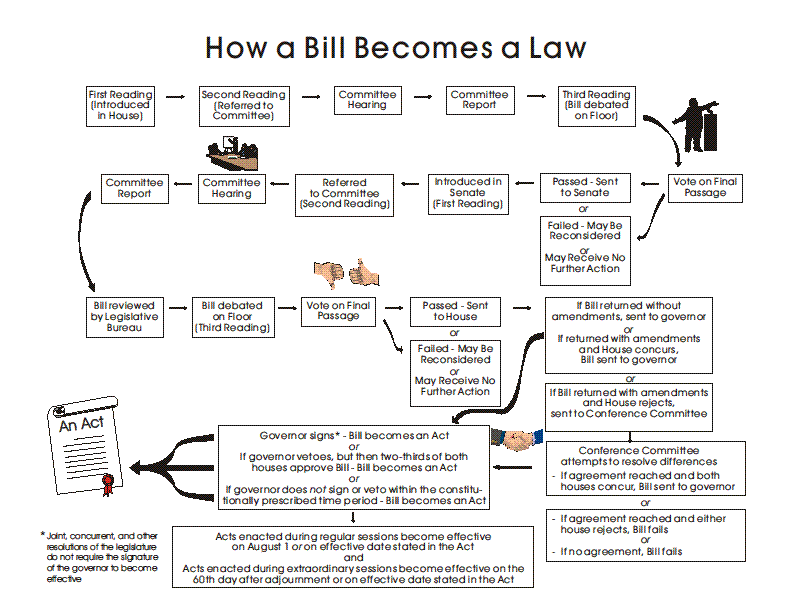
Bill Status
As bills go through the legislative process, their status changes. Because of this, you will notice different versions of the bill.
- Original – The first version of a proposed law, before any changes (amendments) are made.
- Engrossed – The original bill with committee amendments (changes) included.
- Reengrossed – An engrossed bill with floor amendments included. Floor amendments are changes or additions made to a bill during a legislative session in the House or Senate.
- Enrolled – The final version of a bill, with all approved changes from both houses, sent to the governor for approval or veto.
- Act – A bill passed by the House and Senate and signed by the governor (or allowed to become law without his/her signature). In Louisiana, laws are called Acts.
The Budget Process

Executive Budget
The Executive Budget is the governor’s plan for how the state will collect and spend money in the upcoming fiscal year. It outlines the administration’s priorities. It proposes funding for programs and services. This budget serves as a starting point for discussions with the state legislature. The legislature reviews, changes, and approves the final budget. The state’s fiscal year runs from July 1st to June 30th.
The budget process takes a year and can change. Here is an example:
| August | Departments begin preliminary budget discussions. This usually takes place internally among agency heads and staff. |
| September | The Division of Administration provides departments and agencies with budget request forms for the upcoming fiscal year. |
| November | Budget requests due back to the Division of Administration. |
| December | Division of Administration reviews and makes changes to the request amounts and presents preliminary budget recommendations to departments and agencies. Agency appeals process begins. Executive Budget recommendation made to the governor. |
| January | Executive Budget is printed. Executive Budget due to the Joint Legislative Committee on the Budget 45 days prior to the start of the regular session. |
| February | Executive Budget presentation to the Joint Legislative Committee on the Budget. General Appropriation Bill filed no later than 14 days after submission of the executive budget. House Appropriations Committee hearings begin. |
| March | Legislative session begins. |
| April | House Bill 1 to be heard in House Appropriations Committee and on the House Floor. |
| May | House Bill 1 to be heard in Senate Finance Committee and Senate Floor. Conference committee if necessary. |
| June | Legislative session adjourns. Governor signs the bill with vetoes. Fiscal Year ends June 30. |
| July | Appropriation letters are mailed to departments. New fiscal year begins July 1. |
General Appropriation Bill
The bill provides funding for the day-to-day operations of the government. This includes the expenses of the executive branch. Usually known as House Bill 1.
There are other appropriation bills. They include the Capital Outlay Appropriation Bill, Supplemental Appropriation Bill, Ancillary Appropriation Bill, and others.
State Budget
The state budget is the plan for how the state will use its money and resources after all funding and revenue bills are passed.
What to Expect


Tracking Legislation
Want to keep track of bills during session? Know when committee meetings are scheduled? Watch committee meetings online? Click here for our Navigating the World Wide Web: A How-To Guide for Advocates.
Click here for How to Write/Email Your Legislator.
Click here for How to Write Your Story.
Click here for How to Provide Public Testimony